
Why You Can't Just "Calm Down": 7 Signs Your Nervous System Is Stuck in Survival Mode
Many of us living in New York City are what I call "functionally anxious." You're highly self-aware and reliable. You get your work done, show up for friends, attend social events, squeeze in workout classes, and keep a full calendar.
You aim to make the best of your day. On the inside, though, your mind rarely slows down. You're constantly thinking about the next thing on your to-do list, replaying conversations, worrying about what you should have said differently, or holding a constant sense of restlessness as if your brain has a hundred tabs open at once.
You may find yourself wondering, "Why can't I just calm down when my life is actually okay?" It's easy to assume you're simply overthinking or always wanting more. But often, that's not what's happening. It’s your body constantly being on alert. Your nervous system may still be in survival mode and responding as though danger is present, even when you're objectively safe.
So, what does it mean to be stuck in survival mode?
Your nervous system is designed to protect you. When your brain senses danger, it automatically shifts into survival mode, often known as the fight, flight, freeze, or fawn response. Your heart beats faster, your muscles tense, your attention narrows, and your body prepares to protect you. This response is incredibly adaptive when you're facing a real threat. The problem is that after chronic stress, trauma, or prolonged periods of feeling unsafe, your nervous system may continue responding as though danger is still present, even when your life is relatively safe today. Being "stuck in survival mode" doesn't mean you're weak, broken, or doing something wrong. It means your nervous system has become very good at protecting you, but hasn't yet realized that the threat has passed. As a result, you might constantly feel on edge, struggle to relax, experience chronic muscle tension, become easily overwhelmed, or find it difficult to feel safe in relationships. These are not simply "thinking problems", they're whole-body responses shaped by your nervous system.
If this sounds familiar, here are seven signs your nervous system may be stuck in survival mode.
1. You constantly feel on edge or hypervigilant
Even when nothing seems "wrong," your body may still be scanning for what could go wrong next. You might find yourself constantly checking your surroundings, feeling startled by unexpected noises, or noticing it's difficult to fully relax. It can feel like your body is always waiting for something to happen, even when you're objectively safe. If you've ever wondered why you always feel "on edge," this may be a sign that your nervous system is still operating in survival mode.
2. You're always tired but can never fully relax
One of the most frustrating experiences is feeling exhausted throughout the day, only to find yourself wide awake when it's finally time to sleep. Your body feels tired, but your mind won't stop racing. Even after a full night's sleep, you may wake up feeling as though you never truly rested. When your nervous system is constantly working to keep you alert, it can be incredibly difficult to experience genuine rest.
3. Your body is always tense (jaw, shoulders, stomach, and more)
Sometimes we become so accustomed to carrying tension that we stop noticing it's there. Maybe your jaw is clenched without realizing it, your shoulders are always tight, your stomach feels knotted, or your hands stay tense throughout the day. Many people also unknowingly hold chronic tension in their pelvic floor. These are common signs of nervous system dysregulation.
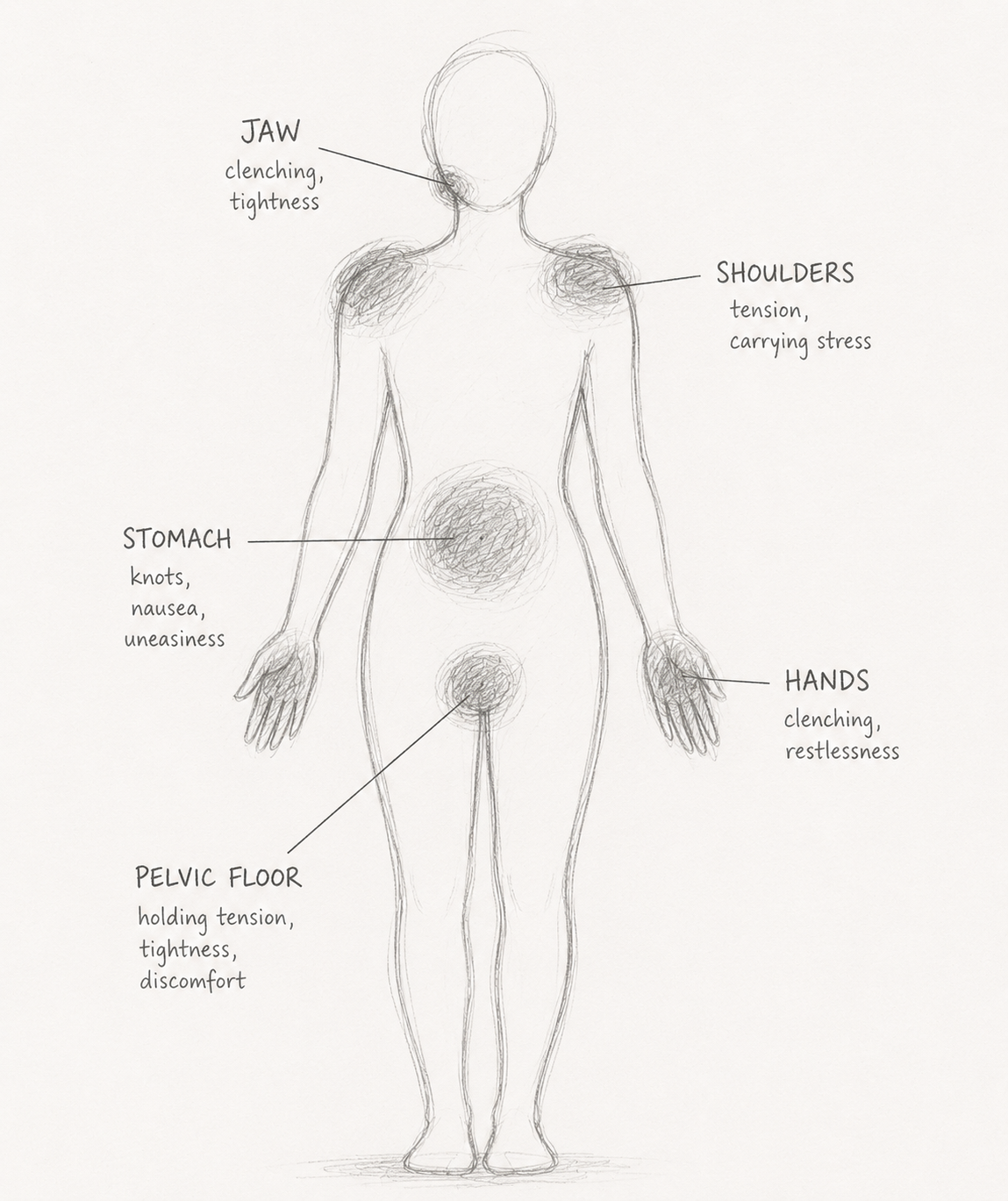
Notice if any of these parts of your body carry tension.
4. Small stressors feel like major emergencies
When your nervous system is stuck in survival mode, it can't always tell the difference between a real threat and an everyday inconvenience. A delayed email, someone sounding slightly annoyed, traffic, or an unexpected change of plans can trigger the same stress response your body would have during actual danger. If you've ever thought, "Why did I react so strongly to something so small?" you're not alone. It often because your body learned in the past that it was not safe to not do everything in perfection.
5. You feel numb, disconnected, or "check out"
Not everyone responds to stress by becoming anxious or restless. Sometimes the nervous system responds by shutting things down. You may notice brain fog, feeling emotionally numb, difficulty staying present, or feeling disconnected from yourself or the people around you. Some people describe it as going on "autopilot" or watching life happen from the outside. This is often called a freeze response. Rather than fighting or fleeing, your nervous system protects you by reducing awareness and conserving energy. While this response may have once helped you survive, it can leave you feeling disconnected long after the danger has passed.
6. You have difficulty feeling safe in relationships
Survival mode doesn't only affect how you respond to stress, it can also shape how you experience relationships. You may constantly read other people's emotions, worry you've upset someone, avoid conflict, or find yourself putting other people's needs before your own. Trusting others may feel difficult, even when they've done nothing to lose your trust. These patterns often develop when important relationships in the past didn't consistently feel safe, predictable, or emotionally secure. Over time, your nervous system learns to stay alert for signs of rejection, criticism, or conflict, even in healthy relationships.
7. You know why you do it—but still can't stop
One of the things I hear most often is: "I know exactly why I react this way, but I still can't change it."
Insight is incredibly valuable, but insight alone doesn't always change how the nervous system responds. Trauma isn't just stored only in our memories or thoughts, it is also heavily reflected in automatic body responses that developed to help us survive.
The good news is that the nervous system is remarkably adaptable. Through approaches such as Sensorimotor Psychotherapy, EMDR, and other body-based therapies, it can gradually learn to recognize safety again and respond with greater flexibility instead of remaining in survival mode. This is one of the reasons our New York City therapist team at Moment Psychotherapy often integrate Sensorimotor Psychotherapy/ Somatic Therapy/ EMDR Therapy into our work. Rather than focusing only on understanding your story, Sensorimotor Psychotherapy and EMDR therapy works with the body's survival responses. By gently increasing awareness of physical sensations, movement, posture, and nervous system activation, we can help your body gradually experience safety again.
We will not force your system to "calm down”; instead, we help your nervous system learn that the danger has passed.
